By Robbie Chamberlain
The Scene staff
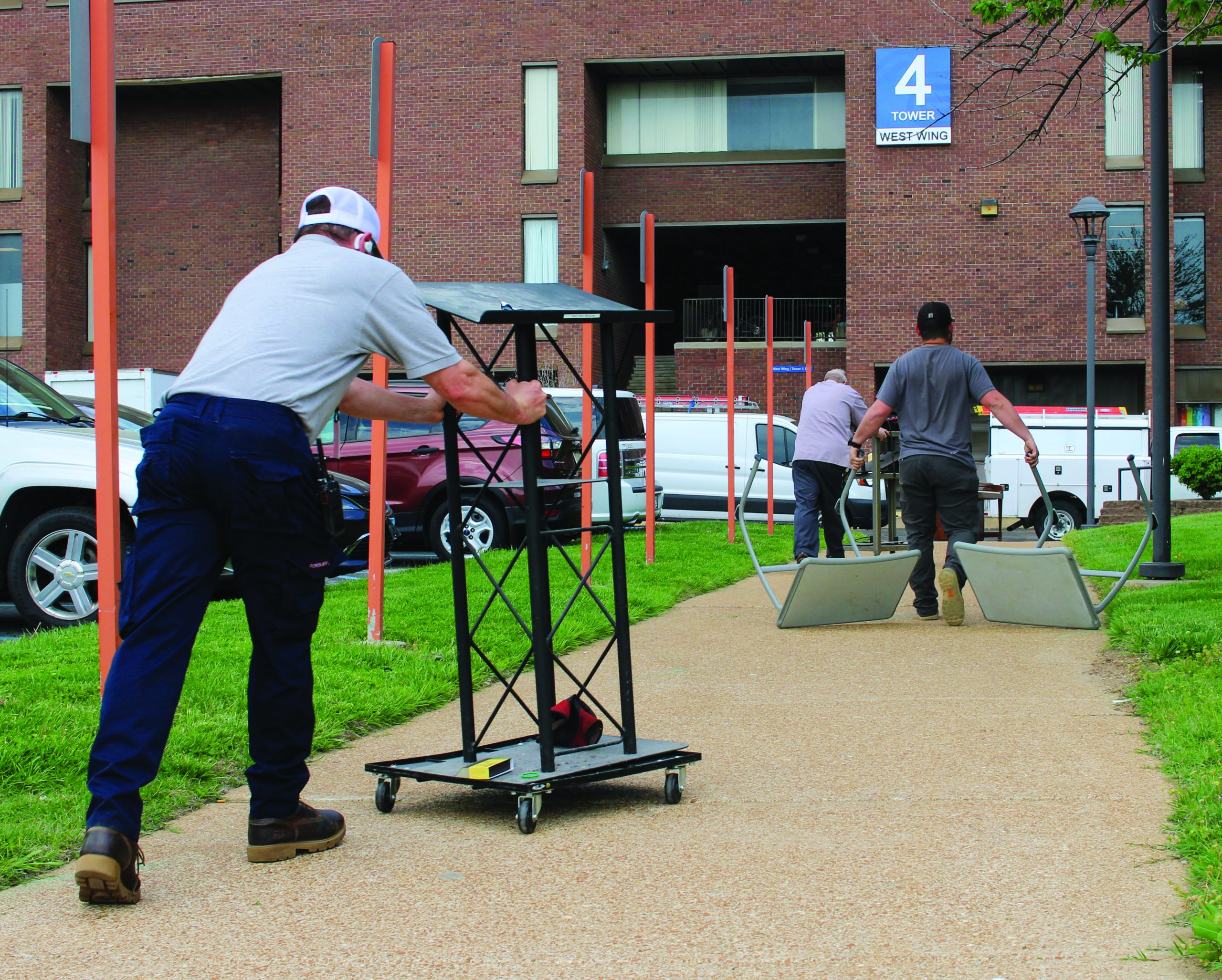
Every now and again, Forest Park students see employees hauling loads of furniture, electronics and office equipment away on carts.
What they may not realize is that the college is sending hundreds of items, some relatively new, to landfills every year. Last spring, workers even used a forklift to drop an upright piano into the giant dumpster next to the loading dock.
This practice isn’t new.
St. Louis Community College has for years had a policy that allows surplus property to be thrown away if items are not considered valuable enough to be auctioned by the accounting department.
“We don’t have a warehouse anymore, so we either have to store stuff temporarily or we have to get it where it’s needed,” said Hart Nelson, chief operating officer for STLCC.
“I’m not a believer in just holding onto stuff because it just piles up.”
Nelson noted that renovations being completed under the STLCC Transformed initiative have accelerated the need to cycle out older items.
Why not donate?
STLCC doesn’t donate surplus property to nonprofits or charities for several reasons, according to Nelson.
As a public institution, it can get complicated and cause ethical problems trying to decide which organizations should receive taxpayer-funded items.
“If the individuals who run our surplus process say, ‘I’m going to give it to this church or this 501(c) nonprofit,’ they’re picking winners, right?” Nelson said.
“In addition to the concern of ‘how are we picking that person who gets this equipment or these supplies,’ we’re not maximizing value. If it’s a donation, we’re getting paid zero.”
Nelson pointed out that public institutions cannot get tax write-offs for donations, unlike private companies.
So, for items that do have value, a better option is auctioning them on GovDeals.com, Nelson said. It is a website for government agencies and other public institutions to auction property.
Filling dumpsters
At Forest Park, unwanted items that aren’t sold at auction are carried outside and thrown into dumpsters next to the loading dock. The items are picked up by Waste Management, a company that the college contracts to haul away regular trash.
It’s not known how much STLCC pays the company. The Scene filed a public-records request under the Missouri Sunshine Law for five years of invoices and contracts related to surplus property disposal on the Forest Park campus.
The newspaper determined it wasn’t in a position to pay the $372 the college required to have administrative staff spend an estimated 15 hours retrieving the information.
Waste Management doesn’t deal with old or unwanted electronic equipment. That is handled by an E-waste recycler through the information technology department.
The third-party recycler can refurbish and resell some items, netting the school some profit, Nelson said.
Muhamed Hadziselimovic, senior manager of campus IT for Forest Park, didn’t respond to requests for more information.
The process
Under the STLCC Board of Trustees policy on surplus property, items with an original purchase price of more than $5,000 are logged as “fixed assets” in an inventory. These assets need board approval for disposal.
However, if a fixed asset has been determined to have “no additional value to the College,” it can be “disposed of immediately.”
Surplus property with a lower purchase price is thrown away at the discretion of business managers and building managers on each of the college’s four campuses, according to the policy.
An outline of surplus procedures advises staff to list unwanted property as being in “poor condition.” It directs questions to Melinda Watson, senior accountant of finance.
Watson declined The Scene’s request for an interview and referred questions to the marketing and communications department.
When STLCC employees identify items, particularly furniture, that are no longer needed, Nelson said officials ask two questions.
“First thing we look at, ‘Is there any other place on campus where this furniture will work, and (is it) better than what we have now?” he said.
“Second part, and this happens frequently with Transformed, ‘If we can’t use it at Forest Park, or it’s not better than anything at Forest Park, can we use it somewhere else across the district?’”
Determining value
If the accounting department determines an unwanted item has no value to the college, employees submit a ticket for facilities to pick it up, according to board policy.
“We look at the accounting value, if it’s fully depreciated, that’s accounting basics,” Nelson said. “… I’m not talking about ‘could someone possibly find any value in it.’ That’s what an estate sale, a flea market or a garage sale is about.”
From there, the college either puts the property up for public auction or sends it to a landfill. Waste Management hauls it away with trash at no additional cost.
Nelson said the college has found it hard to auction off many items, especially furniture.
“This is something a lot of folks don’t understand,” he said. “There is almost zero value in used furniture. Our furniture is 15 to 20 years old, not in great shape, and a lot of what we have is office-style furniture.
“We’ve tried furniture sales in the past. We do not get people interested in them because of the real estate market, the office space market.”
Nelson said that even when the college has listed large lots of furniture on GovDeals.com for as little as a dollar, very few people bid on it.
However, in January this year, a lot of Florissant Valley campus furniture sold for $8,551 at auction. Another lot from the Meramec campus sold for $58.50 in April.
Decisions on what to do with surplus property often come down to the highest potential for maximizing profit.
“We are a public institution, and our mission is to maximize the value,” Nelson said. “We maximize how much the college brings in. We minimize how much we’re paying to have stuff hauled away.”
Campus transformed
Recent renovations have accelerated the need to dispose of furniture, equipment and other property on STLCC campuses. According to Nelson, this process is different than that of normal surplus property.
“With Transformed, we’re not doing trash removal; we’re doing demolition,” he said. “We got contracts to demolish buildings. … Bidding includes demolition and removal of all the things in the buildings. You’ve seen it with renovations at Forest Park.”
During renovations, the surplus process can be used for some things. However, contractors doing demolition and renovation routinely throw away old furniture and fixtures.
“Either us or a contractor named Cort will clear out the areas for the contractors, so they have a clean slate to work with,” said Eric Wille, manager of facilities at Forest Park.
STLCC Transformed is expected to be concluded at Forest Park by June 30, 2027. Nelson believes that the initiative’s end will lead to large downturn in the amount of surplus property.
“Because of Transformed … We’ve been able to do a lot of deferred maintenance,” he said. “(There is) 1960s, 1980s furniture going away, and we’re going to be putting new furniture in. That is one of the reasons why you absolutely were seeing more things surplused and gotten rid of, because we have the funding to go in and get new furniture.”