By Andrew Gausch
The Scene staff
“If you’re expecting a typical art exhibition, this isn’t that.”
This is how photography professor Jamie Kreher describes an art installation that she recently created with her husband, Brett Williams.
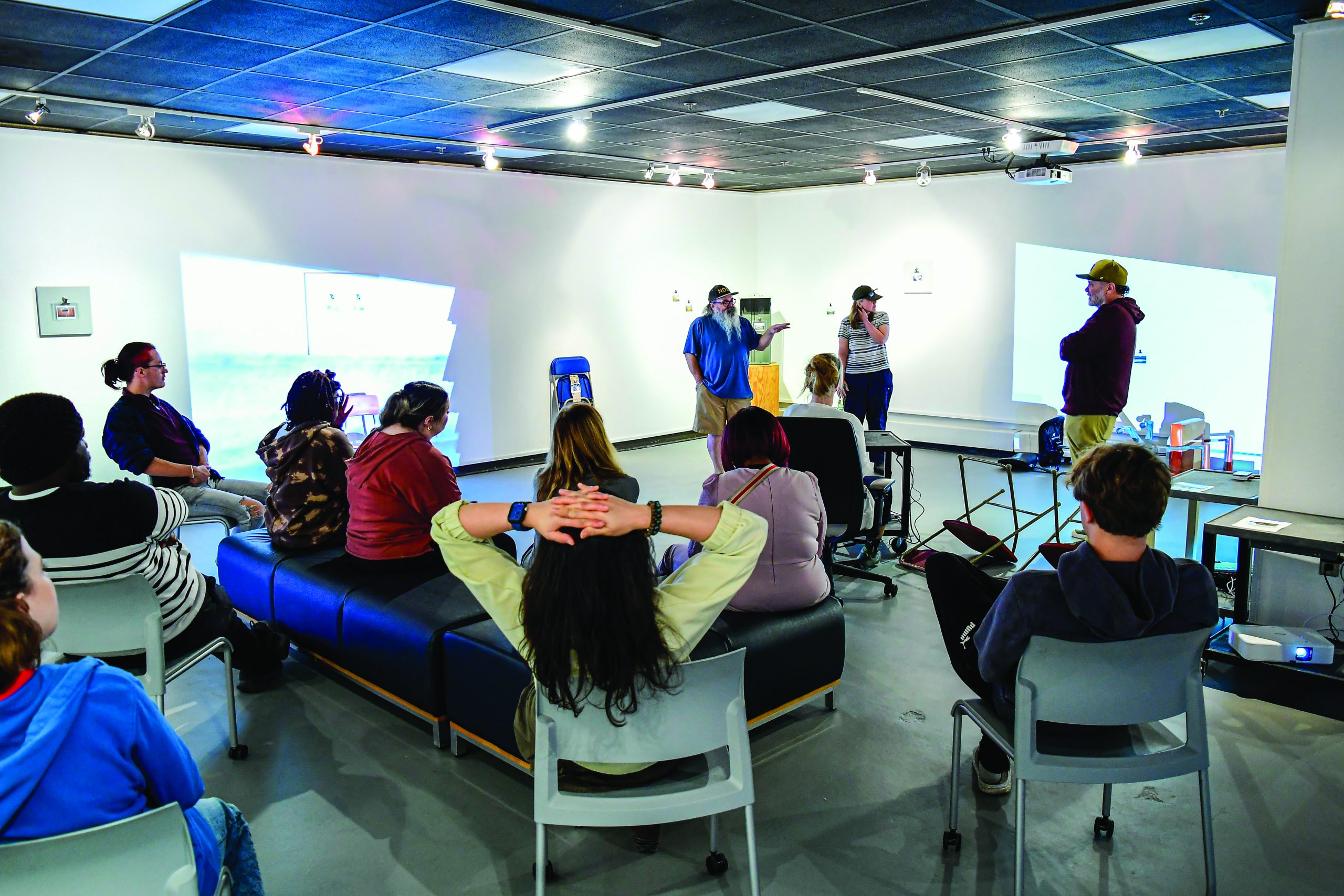
The installation, called “Kreher Williams Research & Development is Data Driven,” spent most of October in the Gallery of Contemporary Art on the Forest Park campus.
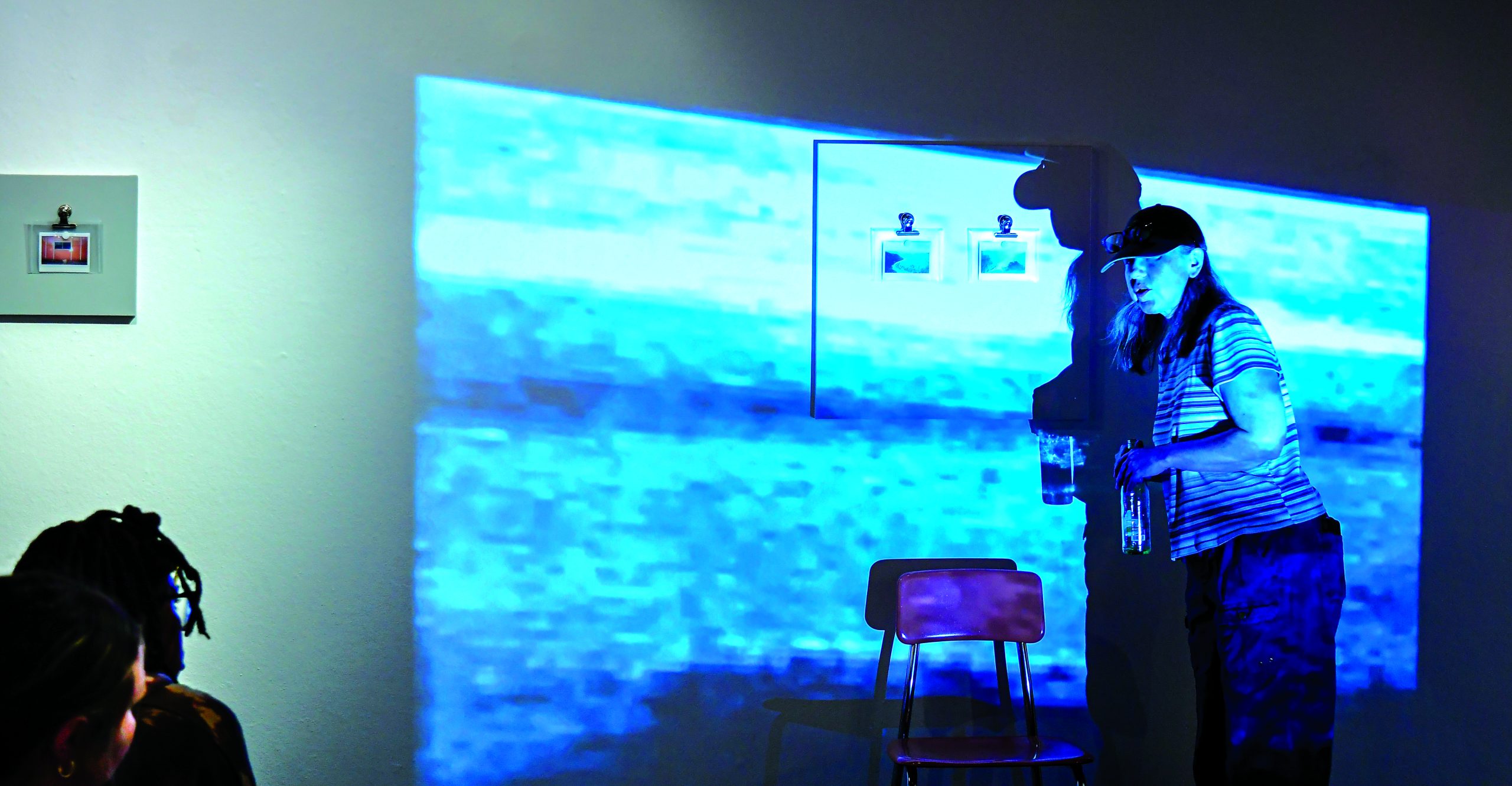
The couple projected distorted film images onto small, Polaroid-style photos, some tacked to the wall and some taped to overturned furniture, a lamp and other objects.
Sound effects ranged from bird sounds to mechanical tapping and recordings from around a rain-wet bridge. All added to the space’s surreal atmosphere.
Art combines with science
“I had been wanting to use filing cabinets in art for a few years now,” Kreher said with a laugh.
Kreher and Williams have been working collaboratively since 2018. They formed Kreher Williams Research & Development in 2023.
They see it more like the name of a band, rather than a company or organization.
“That’s what artists do in their studios,” Williams said. “They’re researching and developing an exhibition or a work of art, and it’s not really any different than scientists in a laboratory or researchers looking at data to crunch numbers for something to do with corporate America. Artists do the same thing.”
“So, we’re likening our process to those same scientific-method-based processes,” Kreher added.
Kreher has been teaching photography at Forest Park for 16 years. She also serves as photography program coordinator and gallery director.
Williams teaches video art, sound and noise art, time studio (video, sound, performance and installation art) at Webster University and works as a senior educational assistant with St. Louis Community College.
Photos in the “Data Driven” installation are actually Fuji Instax prints, shot during Kreher and Williams’ trips over the years with a camera that’s similar to a Polaroid with a somewhat wider perspective. Each was placed in a clear plastic envelope.
“(The envelopes) could refer to specimen storage containers for artifacts taken from the field,” Kreher said, again providing an art-science link.
The couple created the distorted films with a Fisher-Price Pixelvision toy video camera at various angles. Three videos were projected in loops on walls as angled trapezoids rather than rectangles, some with sawtooth edges.
‘Complete unified experience’
Like other installation art, “Data Driven” is meant to be consumed as a whole, in contrast to traditional art forms, such as individual paintings separated by rooms or categories.
It’s a “complete unified experience,” according to an information sheet provided for viewers.
“By merging the language of the archive, with the aesthetics of the vernacular, by working simultaneously in the registers of art theory and lived experience, and by integrating stillness, movement, and sound into a single special organism, our work invites viewers to inhabit a zone of layered perception,” the information sheet
states.
“Here, landscape is never just scenery, objects are never merely functional, and the data of the archive is inseparable from the subjectivity of its makers.”
According to Williams, “archives” in this case refer to the collective body of work but also scavenged items, such as the filing cabinet and other furniture, as well as photos, films and even people viewing the installation.
Culmination of recent work
Kreher and Williams see the installation as something of a way to make sense of the work they’ve been doing the past few years.
“It was the opportunity to bring all those layers together in a way that made sense to our interests,” Kreher said. “That created that … archive quality, that subjective versus objective, the layering, the imprecise media.”
The couple are also producing a film designed as a companion piece to the installation. The installation was available for viewing by students, faculty and staff Oct. 3 to Oct. 30 in the Forest Park gallery.
Kreher has a bachelor’s degree in sociology from Truman State University and a master’s in fine arts from the School of the Art Institute of Chicago. She also attended STLCC from 1999 to 2003.
Williams graduated from STLCC in 1994 and later earned bachelor’s and master’s degrees in fine arts at the Art Institute of Chicago.
Their first combined work was selected twice in two years to be finalists for the Great River’s Biennial, a collaborative exhibition program of the Contemporary Art Museum in St. Louis and the Gateway Foundation.
Editor’s note: This story has been updated to correct information on Kreher’s title and educational background.