
 By Zachary Hamdy
The Scene staff
St. Louis Community College officials don’t want students to use AI to do their work for them, but they know it can be a great study partner.
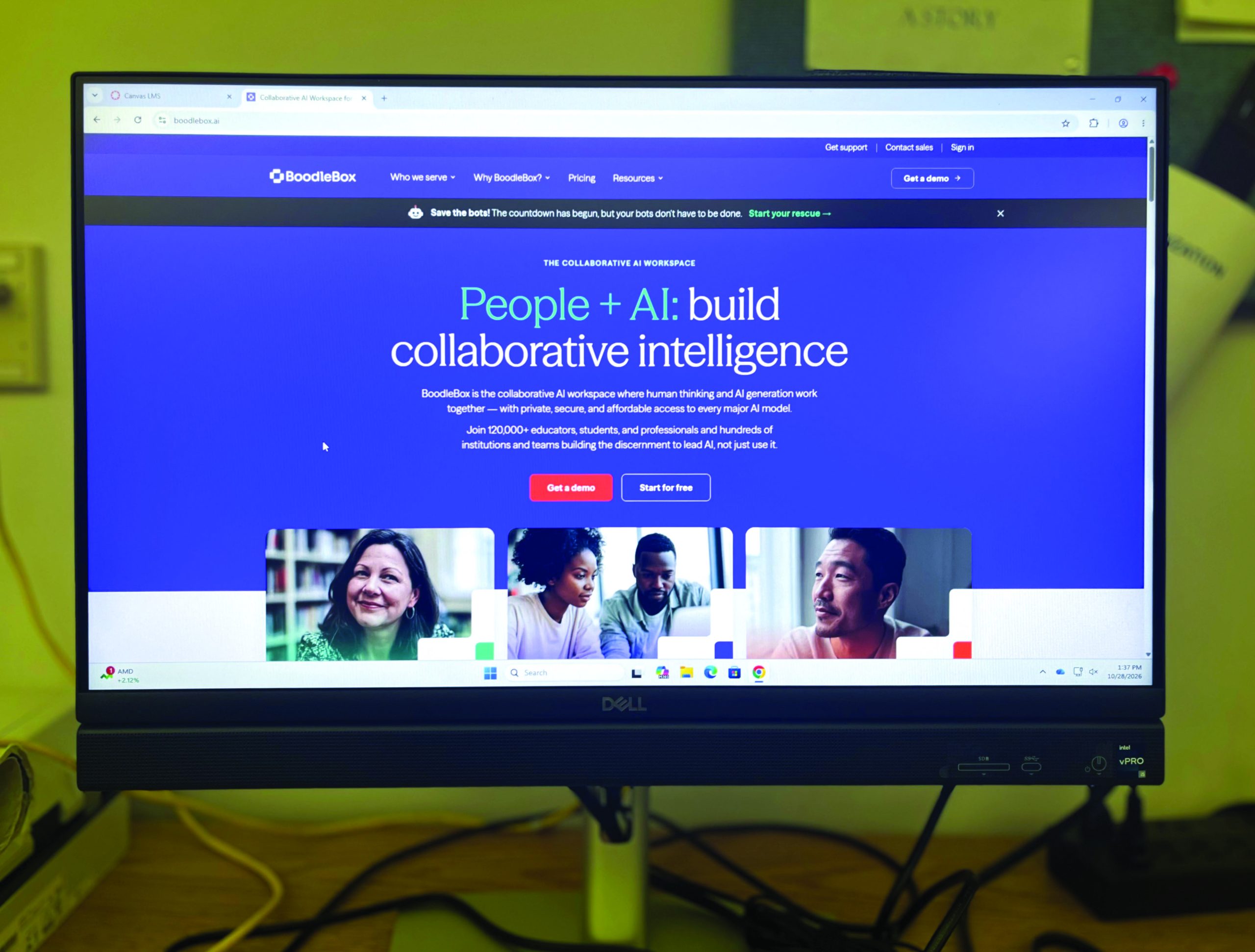
After years of planning and deliberation, the college made BoodleBox its official AI platform this fall.
Administrators and faculty are proceeding with caution, knowing that AI can be abused and interfere with the mission of teaching students how to gather information and think for themselves.
“I am the chair of the AI core team and probably viewed as somebody that’s 100% pro AI,” said Renita Luck, associate vice chancellor for distance learning and academic support.
“I’m very skeptical about where it needs to be used, what tools we need, and ensuring that privacy rights are in place, using the best models to ensure that we’re not leaving this huge footprint in the data center, ensuring that students are still learning, and that the institution’s moving forward in a way that’s protecting all of that, not just using it because it’s a new fancy tool.”
BoodleBox is a collaborative workspace that stacks various AI models in one platform. The college is making it available to students, faculty and staff for free.
Students may have noticed that a new course called “Navigating AI with integrity: An STLCC Student Orientation” is listed on their Canvas dashboards. It’s designed to help them use AI responsibly and in a way that assists rather than impedes learning.
“Even though it’s text based, it is designed to be finished in less than two hours,” Luck said. “So, it would be important for students to work through it.
“There’s good stuff in there about how to transfer these skills when you go into the workforce. So, I would encourage students to take the course.”
BoodleBox can be used to create study guides, take practice tests and get extended explanations of complicated concepts.
Faculty members have the option of using BoodleBox as part of their curriculums, but it’s not required.
Forest Park students have mixed feelings about the use of AI in education.
“I don’t like AI generally,” said general transfer studies student Isaac Booth, 25. “We’ve spent the past 20 years allowing Silicon Valley tech weirdos to disrupt our society for their own gain … and I think AI is the next step in that chain. We’ve made a machine that can make fake pictures and fake writing.”
Booth said he believes there are meaningful uses for AI, but they don’t have any place in education.
Non-degree-seeking student Frank Rosario, 69, said he doesn’t think educators should “stick (their) heads in the sand,” and they should teach students to interact positively and constructively with AI. But he doesn’t like BoodleBox.
“I just don’t think this ‘BoodleBot’ thing is up to the challenge,” he said, referring to the name of the platform’s virtual assistant.
“I will say, though, it gives us a taste of how meaningless AI exchanges can be. … It’s superficial coated in a vocabulary that, you know, you think you’re really getting something.”
General transfer studies student Nile Winfield, 20, sees good and bad in AI. He thinks it’s “powerful” when people use it as an extension of their thoughts, and it can be a tool for students who need extra help with their studies.
“I think there should be limits to it,” he said. “Like, I can use it as a tool rather than as an end-all, be-all, (where it) solves stuff for you.”
Open AI, the company behind ChatGPT, made its code accessible to the public in December 2022. The following January, STLCC officials started having discussions on AI and how it could affect colleges.
They formed the STLCC AI Governance Committee to “put some guardrails, policies and processes in place,” according to Luck.
“We started looking at not just how do we integrate, do we use it, what do we do,” she said. “But what do we have to do about security? What do we have to do about the human oversight, the human factor? How do we create our strategic plan around it?”
Earlier this year, the committee had discussions with faculty members about if and how AI would be appropriate to help students with certain tasks. Officials emphasized that while AI can be an important tool, it should not replace the learning itself.
Safety is another concern the college had in mind when it was choosing an AI platform. BoodleBox is a “closed system.”
“That means that we are not selling or sharing private information,” said Amy Penick, retention coach of health sciences and a member of the STLCC AI Governance Committee. “… If you use regular Chat GPT … the world has your information and can use it for marketing purposes.”
Penick said the college wants to set students up for success in a world where AI is being used extensively in workplaces. In other words, encourage “literacy” in AI.
“If we don’t give you the proper tools and you go out into the workforce after you graduate … It’s a disservice,” she said. “We want you to be the best that you can be. We want you to thrive in the workplace. We want you to be as competitive as others who may have those skills. And that’s why we gave you BoodleBox.”