
By Chloe Ogier
The Scene staff
A ruling handed down by the government agency that regulates truck driving will cause companies across the country to lose employees who are undocumented immigrants and increase demand for employees who are American citizens.
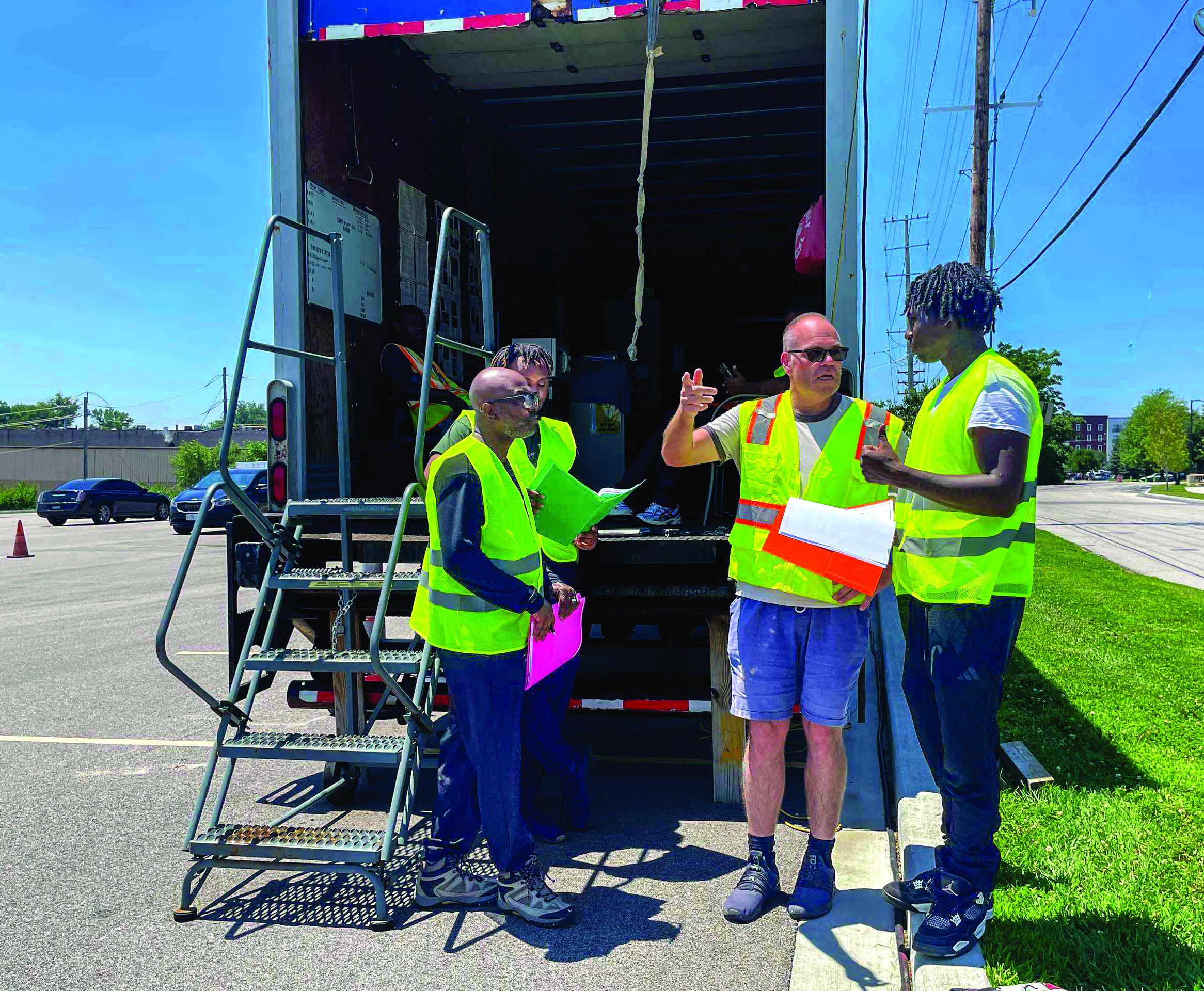
That’s just one of the topics discussed during a recent Truck Driving Expo in the new Transportation Education Center at Forest Park, where company representatives were trying to recruit students from St. Louis Community College.
“There is always a need for truck drivers,” said Bahi Talundzic, manager of the Truck Driving Program at STLCC.
The expo was held June 30. Recruiters sat at conference tables in the downstairs hallway, answered questions and handed out informational pamphlets and business cards to students milling around the area.
They explained the different roads students could take with truck-driving careers — working for smaller local companies whose drivers stay within the city or state, larger national companies that require cross-country trips and everything in between.
STLCC is known for its truck-driving programs, which are based in the new $46 million center, which opened last year. Students can take courses to prepare for certification tests that are required for Class A and Class B commercial driver’s licenses (CDLs).
“It’s really something that’s going to be beneficial for generations to come,” Talundzic said of the new center.
Big change in March
Demand for truck drivers has been high for years. The COVID pandemic, in particular, led to an increase of online product ordering and delivery services.
Then on March 16, the Federal Motor Carrier Safety Administration (FMCSA) ruled that non-domiciled commercial driver’s licenses could be issued only to immigrants holding H-2A, H-2B or E-2 visas. These visas are for temporary agricultural workers, temporary non-agricultural workers and treaty investors.
Immigrants no longer eligible include DACA (Deferred Action for Childhood Arrivals) recipients, refugees, asylees, humanitarian parolees, people with Temporary Protected Status and holders of U-Visas and T-Visas.
 “The current regulations for issuing non-domiciled CLPs and CDLs require States to obtain an applicant’s complete 10-year driving history from all States where the individual was previously licensed,” according to a FMCSA notice in the Federal Register. “… However, States are unable to carry out this requirement for individuals whose driving history exists predominantly or solely within a foreign jurisdiction.”
Opponents of the new ruling argue that it ignores the fact that many DACA recipients’ entire driving histories are in the United States. It also has left companies scrambling to find employees to replace the estimated 200,000 immigrants they will lose.
Immigrants without one of the three accepted visas who had non-domiciled commercial driver’s license or commercial driver’s permits before the ruling will be able to keep them until they expire, but they can’t renew or upgrade them.
CDL terms vary from state to state. Most are valid from three to eight years. The FMCSA is encouraging states to audit non-domiciled CDLs.
“FMCSA strongly encourages States to take immediate action to revoke all unexpired non-domiciled CLPs and CDLs that were not issued in compliance with 49 CFR Parts 383 and 384 in effect at the time the transaction occurred,” the agency states on its website. “… States are strongly encouraged to audit ALL unexpired non-domiciled CDLs and CLPs and identify all credentials that were not issued in compliance with 49 CFR Parts 383 and 384 in effect at the time the transaction occurred.”
Always looking
All the recruiters at the expo said they’re always looking for truck drivers. Some prefer to hire students who have just completed training and certification and not yet picked up any bad habits. Others hope to entice those who have never considered truck driving for a career.
The industry estimates there could be as many as half a million new drivers needed in the next few years, Talundzic said.
Recruiters at the expo weren’t limited to private companies. Two people represented the city of St. Louis.
“Having drivers is very important to the maintenance of the city,” said Todd Hillerman, who works in the city’s personnel department. “They are essential,” added his colleague, Tonya Farr.
In addition to the FMCSA ruling, other factors keep new drivers from entering the field or push older drivers out, according to the recruiters.
One major challenge is the quickly changing technology. Representatives of St. Louis Composting said the company’s decision to install video cameras in their trucks a year and a half ago wasn’t embraced by everyone.
The cameras were added to help collect evidence and testimony in case of an accident, they said. Videos could help show that drivers are acting safely, but many older drivers still find the idea off putting.
In contrast, representatives of Heartland Coca-Cola said that they were finding it difficult to hire new employees because of old technology. All the trucks in their fleet have manual transmissions, and few people are learning to drive manuals anymore.
Other challenges
Several recruiters said Class A commercial driver’s licenses — which are required to drive semis and trucks that haul fuel, freight and loads over a certain weight —seem to be more competitive and harder to obtain than in the past.
Talundzic finds retention to be an industrywide issue, saying that many companies must hire three employees to ensure one will stay for a reasonable amount of time.
“They jump around to seasonal jobs, not realizing how that looks to the employers,” Talundzic said.
Another commonly expressed belief among the recruiters was that the average person doesn’t tend to think of truck driving as a possible career path for various reasons.
Not everyone wants such a labor-intensive job. Martha Sands of the St. Louis Agency on Training and Employment noted that the field is largely male-dominated. Some recruiters also said the industry is underappreciated, despite all that it brings to people’s lives.
“There’s a lot of stigma about truck drivers,” Talundzic said. “They don’t understand the role truck drivers play and their contribution to the economy.”
Despite the challenges, STLCC is working to bring more people into the field of truck driving every day.
The college offers multiple courses, each preparing students for a different level of CDL. Coursework ranges from one-day to five-week programs.
Once students have passed a course, they may take the related certification test. Once they have passed the test, they’re ready to hit the road and apply for jobs.
“Designed to get you road-ready, this training focuses on the skills employers look for in professional drivers,” states the STLCC webpage for the Truck Driving Program. “Funding may be available for those who qualify, making it an accessible path into a high-demand industry.”
Students interested in taking a truck-driving course can click here or attend a weekly information session from 9:30 a.m. to 3:30 p.m. Thursdays at the Transportation Education Center.