
 By Robbie Chamberlain
The Scene staff
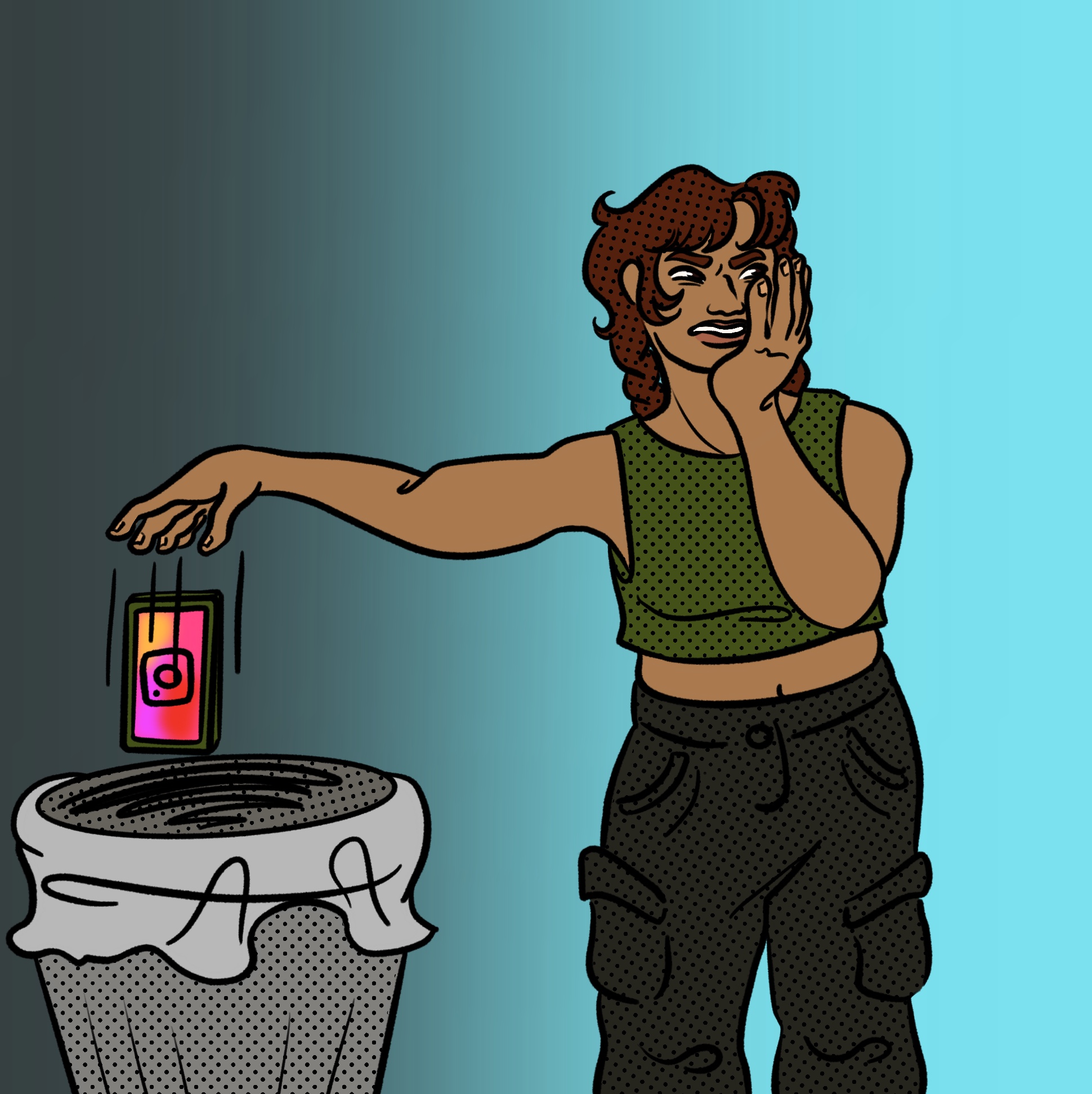
For the love of what little is left sacred in this world, please delete your social media. The industry has become poison to its users for the sake of financial gain.
Don’t get me wrong, I understand how challenging a proposition that is right now. We all live in a world dominated by social media. It’s become the most prevalent medium for entertainment, news, community organization and more.
However, I feel as though we’ve been betrayed by Silicon Valley snake-oil salesmen.
These free platforms that many of us have allowed into our lives have become massive wells. Social media algorithms drip-feed users pernicious content, then pull up buckets of ad revenue and data.
It’s an open secret that the algorithms push divisive and negative content that feed on and confirm our biases. A Stanford study and others have found that negative, arousing content is boosted on social media.
Additionally, misinformation permeates social media at all levels. It is too easy to encounter false narratives being presented as fact, as well as facts manipulated and disguised to support false narratives.
As a student journalist, I see this as dangerous because everyone needs a breadth of properly sourced and neutral information to make informed decisions.
It’s a vicious cycle. Nowadays, it is impossible to consult social media and come to a sensible conclusion about any issue. There are too many conflicting viewpoints that hurl falsehoods at each other.
And this isn’t a one-sided political issue. When people talk about media literacy’s downfall, that includes everybody on the ideological spectrum. It seems that social media makes everyone angrier and unable to form structured viewpoints on things. Because when someone actually presents a substantiated argument, who has the time to read all that?
Twitter (or X, I guess) was once described as a “digital town square.” I believe that it has instead become a digital apartment building wherein each unit is playing loud music and blaming it on their neighbors.
Aside from political and ideological conflict, social media continually reinforces a negative mental state in order to keep its users – especially those with pre-existing mental health issues – engorged in the endless buffet of engaging content. MIT researchers describe this cycle as a “feedback loop.”
Just recently, TikTok and Snapchat settled a lawsuit in California regarding their algorithms’ addictiveness. YouTube and Meta cases have yet to reach trial or settle, and dozens more similar lawsuits are on the docket.
The people propagating this conflict stand to gain so much from it, as in they make boatloads of money on the back of our inflamed discourse and sustained attention.
The influencers and e-celebs who dominate the collective consciousness on social media and push discourse serve as a link between the average user and the platform.
Influencers are highly paid and highly visible. Through carefully curated content, they essentially mimic the average user while selling products, ranging from lifestyles to politics, supplements to ideas.
Many of my peers (Gen Z) subconsciously follow this example and curate their own social media personalities, exhibiting them both off and online. We unknowingly emulate and venerate these fake people in our day-to-day lives.
I know this feeling and struggle all too personally. I was probably more Instagram- addicted than the average user at one time. If it can happen to me, my anxiety-ridden peers are also susceptible to seeking the same fruitless validation.
On another note, am I the only one unnerved that the three richest men in our country all head social media platforms? Elon Musk famously bought Twitter, Mark Zuckerberg controls Instagram/Facebook and Larry Ellison recently led the U.S. acquisition of TikTok.
Not only do they control the flow of information on their platforms, they also wield our data and personal information for their gain. Their job as heads of businesses is to “follow the money,” which has entangled our expression and discussion of culture, history, news, entertainment, etc.
All of our data – the things we post, the content we like and engage with – is stored and used for surveillance marketing. You know you’ve talked about a product and seen an ad for it 10 minutes later on Instagram. And isn’t it funny that, as soon as you break up with your girlfriend, your TikTok feed becomes inundated with heartbreak content?
There have been numerous lawsuits and data breaches involving users’ social media data. And people know this. So how come everyone is so resistant to opt out of socialmedia?
I have a friend who only communicates with his partner through Instagram chats. For four years. When I pointed out to him that every written message, voice message and media attachment he has ever sent is the sole possession of Meta, he kind of blankly stared into space and stopped speaking for a moment.
Who knows what sensitive and private information lays dormant in Meta’s servers, subject to being stolen by hackers or scraped up for AI training data?
I won’t go off on a tangent about AI, not in this column.
But the proliferation of AI throughout social media will further erode the trustworthiness of its information, all while making the content much lazier and way more mind- numbing. Why go out with friends and record a funny video when I can have AI generate one that is grafted from thousands of random people’s likenesses?
Before you conclude that I am overly negative, let me say that I know social media isn’t all bad.
At its core, it is a truly wondrous invention. With the touch of a power button and app icon, you can get updates and hear stories of all your friends’ exploits – a grand odyssey to Chick-Fil-A, situationship struggles, vacation photos, whatever updates you need, at any distance.
Social media is the ideal platform for organization, event planning and information dissemination. It cannot be understated just how convenient it makes the establishment of business and community.
With that being said, these things have always been possible with some effort. So, should we really give up our humanity and control for convenience?
My final message: Go outside, lay on the grass, look at the sky and take a deep breath. You’ll get more serotonin than social media will ever provide. Plus, your time will be spent thinking rather than being told what to think.
Consider what social media actually adds to your life and whether you can get it through other means. The answer to the second question is likely “yes.”