By Robbie Chamberlain
The Scene staff
Vending machines can be a source of headaches for Forest Park students, faculty and staff.
They love to complain about high prices, low nutrition, understocking and just general malfunction. Many complain about not getting change or money being taken without products being dispensed.
Criminal justice student David McCoy said that a vending machine in the cafeteria has taken his money six times.
“I counted it,” he said. “I don’t know why I counted it, but I just kept it in my head for some reason … I’ve put probably $10 in cash and $15 in card on it, and the third time is the only time it worked.”
Forest Park has 25 vending machines scattered around campus. St. Louis Community College gets a commission on each sale.
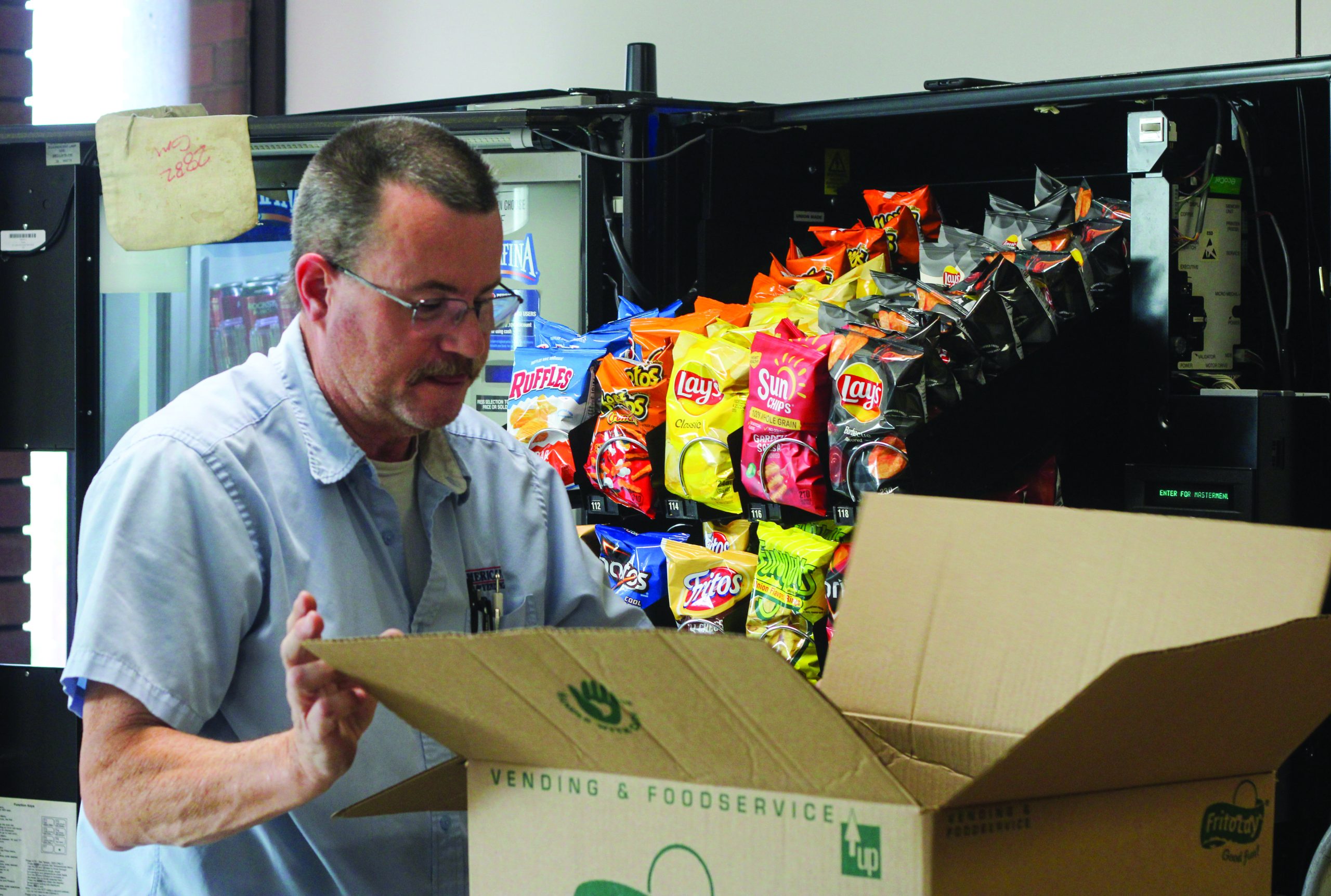
PepsiCo gained “pouring and sipping” rights with STLCC in 2016, giving the company exclusivity to sell beverages on all campuses. In 2023, the college contracted with American Food & Vending to sell chips, candy and other snacks.
Oversight of vending-machine operations is handled by STLCC Auxiliary Services, which also oversees bookstores and mailrooms.
Senior Auxiliary Services Manager Julie Stillman said vending machines give students convenient and tasty food options when they’re on the run.
“People might say they want carrots and hummus or something healthy, but the reason people go to vending machines at the end of the day is they want a bag of chips or a Snickers bar,” she said. “They want something quick and comforting.”
Refund policy
Students used to be able to get cash refunds in the Forest Park bookstore if they lost money in vending machines. But that policy changed when American Food & Vending took over.
Now students must text the phone number on vending machines to get refunds through Venmo or Paypal. Some, including McCoy, say they don’t have time to engage with customer service between classes, opting to forgo refunds entirely.
McCoy said he’s never had the problem of losing money in vending machines on the Meramec or Florissant Valley campuses.
“Only on this campus,” he said. “… I don’t know what’s wrong with this school.”

Rodney Jones, auxiliary services manager at Forest Park, referred questions to David Petersen, a general manager at American Food & Vending. Petersen declined to comment for this story.
On PepsiCo’s website, the company promises to send drink vouchers to people who lose money in beverage machines.
General transfer studies student Carlos Barragan said he generally has had good experiences with beverage machines on campus, except for an incident involving Gatorade.
“When you buy the Gatorade, it’s too big to come out,” he said. “Yeah, I bought it, I used my card, and it didn’t come out, and it just gave me a bunch of coins back.
“I got my money back, but that’s like the only problem, really. Other than that, everything’s perfectly fine.”
Empty machines
Forest Park students have also complained about inconsistent stocking and product availability. Several beverage machines have also gone out of order since fall semester began.
Such disruptions are usually a result of network failure, according to Jones.
“The machines lose connection because they’re all connected to wireless and to accept the card, they have to be connected,” he said. “So sometimes they lose connectivity, and that happens a little bit more often with Pepsi than it does with (American Food & Vending).”
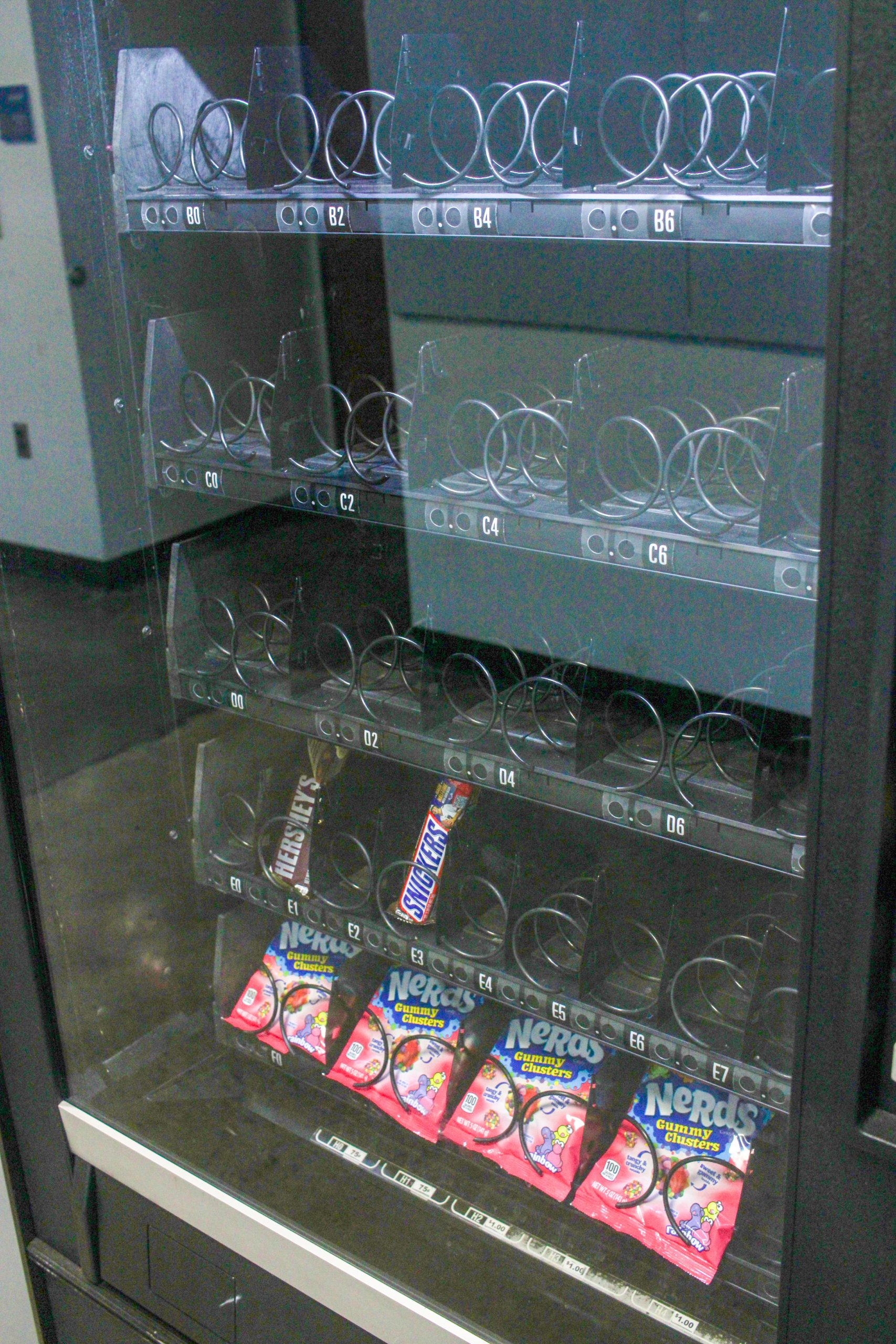
The companies are supposed to restock vending machines on Tuesdays. But it’s not unusual for them to be near empty. One machine on the fourth floor of West Wing sat for weeks with only four bags of Nerds clusters and two candy bars until it was recently restocked.
Stillman said one reason for understocking is the transition between semesters. She noted that PepsiCo lagged a bit at the beginning of fall semester.
“Over the summer, the volume slows down significantly on campus, so they don’t need to fill as often,” Stillman said. “So (when) August or September rolls back around, we need that volume again at a higher level. And that takes some adjusting for those companies that have decreased that labor and stock over the summer.”
Vending-machine products are sold at a markup, which takes into account operational costs and margins. General transfer studies student Roya Porshahidy sees price points as inconsistent.
“Why am I buying a Gatorade for this much at a cafeteria vending machine when I could get it in the cafeteria?” she asked. “That’s not right.”
Prices are set by the vendor, not by the college, Jones and Stillman said. And it’s true that they’re higher in vending machines than in grocery stores.
A 20-ounce bottle of Pepsi costs $2.75 from vending machines at Forest Park compared to $2.38 at Walmart. Prices are $3.50 versus $2.54 for a “share-size” bag of M&M’s and $3 versus $2.18 for a 20-ounce bottle of Pure Leaf Tea.
Stock options
Vendors also decide which products are offered in vending machines and typically choose them based on stock availability or purchasing trends, according to Stillman.
Some students, such as Barragan, are content with the options at Forest Park.
“The stock’s pretty good actually,” he said.
Forest Park tutor and general transfer studies student Rowan Hoppes disagrees.
“(With) Celsius, you have a wide variety of all of the good flavors, and they always stock the freaking orange Celsius flavors in the vending machines,” Hoppes said. “And it’s because they don’t have to stock it as often, because no one likes to drink it.”
Hoppes also believes that there should be more nutritious options in vending machines.
“We should do a better job of trying to provide students with things that aren’t just 90% sugar or sodium,” Hoppes said. “They Jones have a million and one options of what they could stock, and they forever will stock the things that are worse for us as humans to be consuming, because it’s more convenient for them and more convenient for us to buy.”
People with complaints about vending machines can pass them on to their departments or directly to auxiliary staff. Stillman said she and Jones will then coordinate with vendors to rectify any issues.
Communication with American Food & Vending is easier and faster than it is with PepsiCo, an international conglomerate, according to Jones.
“David’s always getting back to me right away, and I often text him on my phone,” he said. “If there’s a problem, I’ll be standing in front of the machine, and I’ll take a picture, show him what the problem was, and he gets right back to me with a solution.
“Pepsi is a large company. … It’s more impersonal. There are different entities of Pepsi that work with different vendors like the dining services.”
Stillman encourages students to voice their concerns about vending machines to make the experience better for everyone.
“The idea of taking a process and improving it and creating the best partnership possible with that vendor is my consistent goal,” she said. “It’s never perfect, absolutely not. And when I think it’s perfect, it’s definitely not perfect.
“If a student, or faculty member, especially a student, had any kind of feedback, I welcome it with open arms because we’re all here for the students, right.”