By Chloe Ogier
The Scene staff
Students and faculty in automotive-related departments feel like they’re in heaven.
The new Transportation Education Center at Forest Park has 79,000 square feet of offices, classrooms and garage space, ceilings high enough to accommodate 16-wheelers, equipment with the latest technology, modern fixtures and gleaming floors and natural light streaming in from big windows.
“It’s an all-around upgrade,” said Joe Jackson, chair of the automotive technology department.
Billy Walker, a second-year student in automotive technology, summed it up in one word: “Beautiful.”
St. Louis Community College broke ground on the new $46 million center in October 2023. Doors opened in August, just in time for fall semester.
The center is meant to give students in automotive-related departments a modernized and improved experience, according to the STLCC website.
“The technology is the latest and greatest in the industry,” Jackson said.
The center houses the departments of automotive technology, truck-driving, diesel technology, automotive service and automotive vehicle inspection and light maintenance.
They were formerly located in three different places on campus. That included a garage with seven bays in the West Wing basement.
Fifty to 80 students in the relatively small space spent much of their time waiting for openings so they could get hands-on experience, according to students and faculty.
View more photos of the Transportation Education Center.
“Everyone was on top of each other,” Walker said.
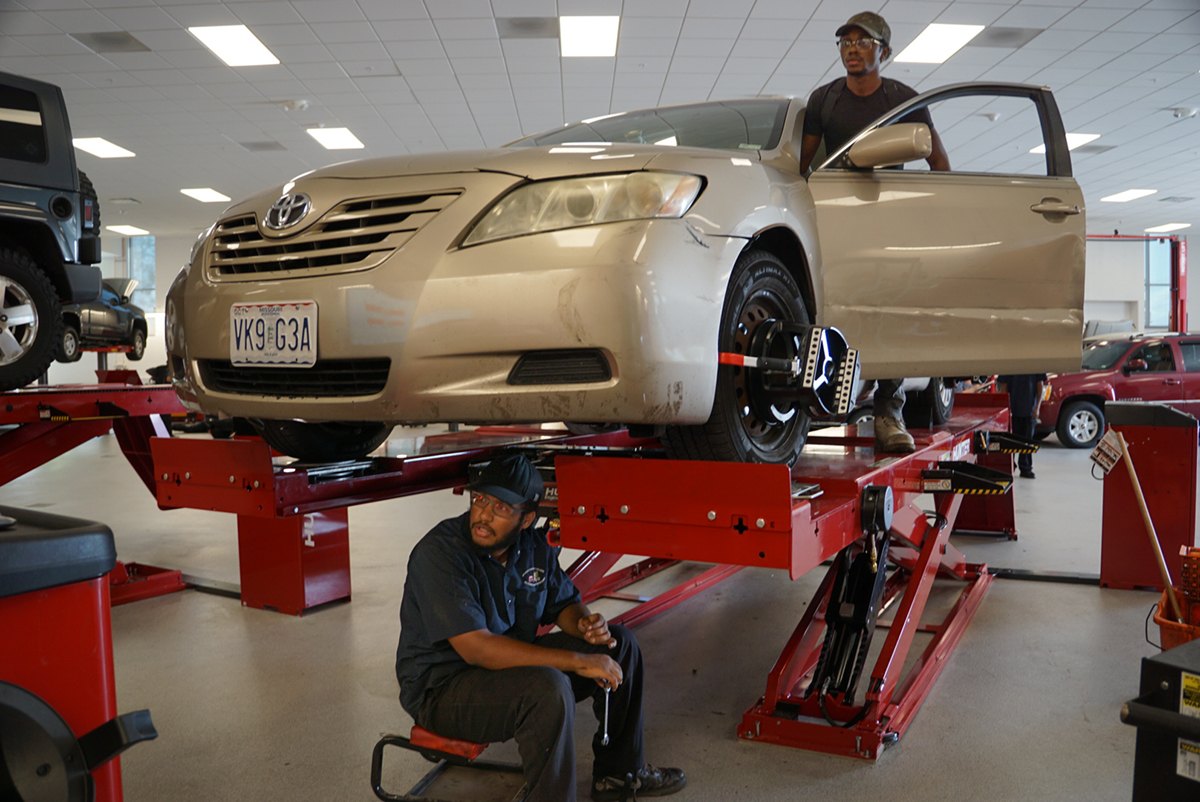
The new garage has computers in every bay, as well as tire-rotation and oil-deposit stations. That means students only have to leave to retrieve parts or tools.
The garage’s former location was also less than optimal from a safety standpoint, according to Professor Joseph Haynes. He doesn’t remember any accidents, but the risk of a collision was always present due to drivers in the parking lot not paying attention to cars coming in and out of bays.
“It was kind of awkward, especially to pull cars out because people would be driving past or leaving because that’s the way you get out,” Haynes said.
The new center also has a separate tool and parts room that is very popular. First-year student Matteus Jong said it has every tool and part that he would ever need.
“We’re able to get a lot more work done by not having to search and scramble for parts,” said second-year student Damarion Robinson.
Haynes said faculty members are still moving things over from the old garage, but they have completely stopped teaching there. They expect to be able to fit everyone and everything they need in the new center.
Jackson pointed out that the center is also adaptable for future technology and conducive to change. Faculty members can’t know exactly where the industry will go in the future, but they are ready for it.
New technology that students are excited about include a sensor reprogrammer, which can reset airbag sensors; and a frame machine, which pulls bent frames back into shape.
Two classrooms also have vehicle lifts, allowing students to see under cars while learning about repair techniques, according to Haynes.
“I love the posts, the fact that they have hydraulics,” Jong said.
Jong said he was surprised by how clean the center is being kept. He expected it to be a lot dirtier by now, considering students are working with grease and oil all the time.
There seems to be a general consensus that the increase in lighting makes it easier to get things done. Haynes also expects the natural light to have a positive impact on students’ mental health and morale.
Enrollment in automotive-related programs has doubled this semester, according to Jackson. Faculty directly attribute this to the new center.
For the first time in the history of the automotive technology department, they are starting two first-year day programs with both full.
“Within the first couple weeks we had the entire shop full, (and) we got every student on a rack,” Haynes said.
The new center is part of STLCC Transformed, an initiative to spend about $450 million on improvements for the college’s four campuses. It was made possible by passage of Proposition R in a special election in 2021, when district voters agreed to raise property taxes.